
readmore.in
India’s reading and writing register. Who writes, where to buy and borrow, what to read next, where to write: authors, books, awards, bookshops and libraries by city, and readers’ notes.
- What it is
- A six-chapter register of reading and writing in India
- The work
- Data assembly from four public sources, a book-like design, an email and form inbox, a daily build
- Built with
- SQLite, a static build, Cloudflare Workers static assets, D1, Email Routing
- Data from
- Wikidata, Wikipedia, Open Library, OpenStreetMap, our crawl index
- Live since
- October 2026
- Visit
- readmore.in
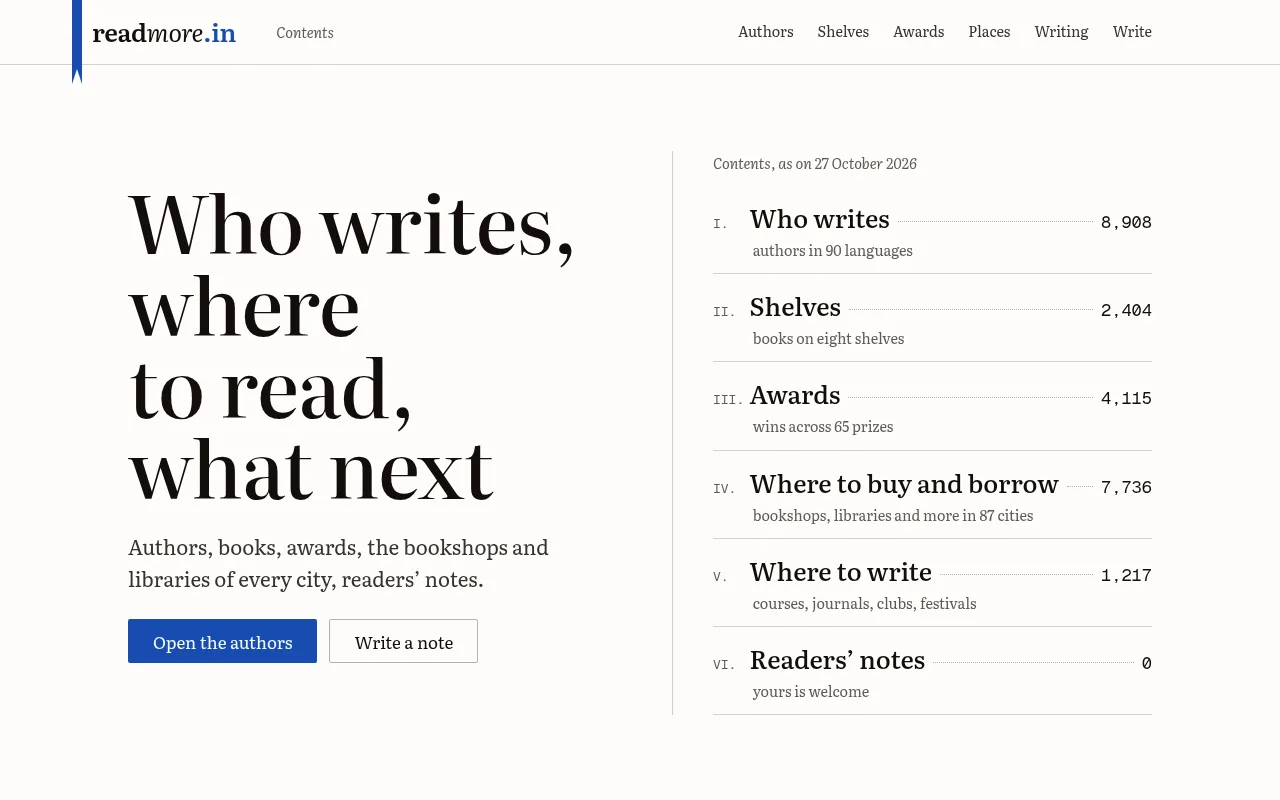
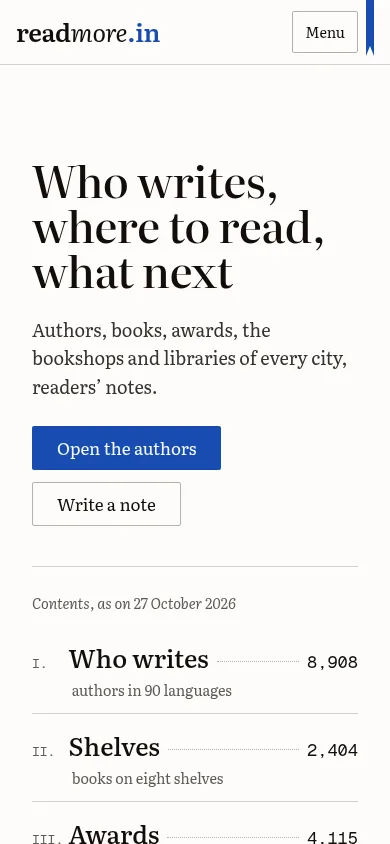
Built like a book, readmore.in opens on a frontispiece and a contents page whose folios are counts on record; the chapters are who writes, shelves, awards, where to buy and borrow, where to write, and the readers’ own notes. Every page names its source in a sidenote, because every fact here comes from a public record and says so.
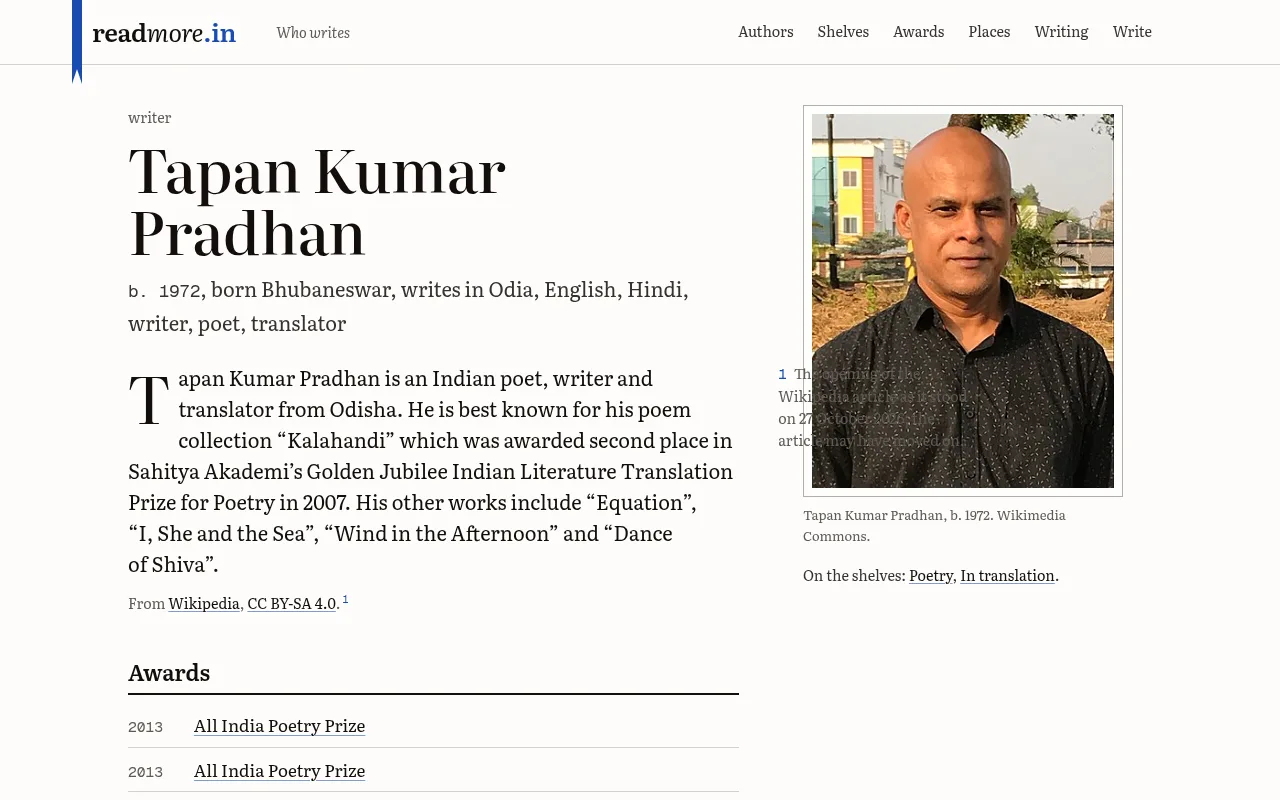
Thousands of writers with Indian citizenship, their books, their languages and their awards come from Wikidata, with the opening paragraph of each Wikipedia article and the cover from Open Library where one exists. Bookshops, libraries, stationery shops and publishers in eighty-seven cities come from OpenStreetMap. Sites for writers come from our own index of the Indian web. Notes arrive by a form or by email to write@readmore.in and are read by a person before they go up.
The work
The design brief was a well-made book: Literata for everything, a fountain-pen blue, a ribbon, a running head that follows the chapter, sidenotes in the outer margin, a reading-lamp mode. A portrait that is missing is typeset initials, never a broken image. Awards are listed by year, and the shelves are derived from what the record says about each book and writer rather than curated by hand.
Two things bit during the build and are worth knowing. Cloudflare counts a directory as an entry in its asset manifest, so twelve thousand index pages blew through the limit and the site was flattened to one file per page without trailing slashes. And a register with that many pages needs its crawler files generated from the data, never typed.
How it is built
A small SQLite file on one of our machines is the pipeline’s memory; a build renders about twelve thousand pages and their JSON into a folder; the folder ships as Cloudflare static assets behind a tiny Worker that handles the form and the mail. A daily job pulls the notes, continues the extracts and covers, rebuilds and deploys. Nothing runs on a server for a visitor’s request.